-
Who This List Is For
-
Step 1: Verify Your POCT Platform Is Actually Ready
-
Step 2: Pre-Load AI-Assisted Interpretation Pathways
-
Step 3: Sync the Imaging Queue — Don't Let a CT Slip
-
Step 4: Prep for the Cardiac Stent Pathway — Even If You're Not Sure Yet
-
Step 5: Don't Forget the 'Non-Urgent' Urgent — Prosthetic vs Orthotic Consult
- Three Common Pitfalls (And How to Avoid Them)
-
Bottom Line
Who This List Is For
If you've ever been the one person in the ED at 2:47 AM with a crashing patient, a suspicious ECG, and the lab's phone ringing off the hook, this checklist is for you. I coordinate urgent diagnostic workflows — think cardiac markers, coagulation panels, and yes, the occasional last-minute imaging request for a trauma that rolled in 10 minutes ago. Over the last 8 years and roughly 1,200 acute cases, I've learned one thing: the five minutes you spend checking before you start can save you five hours of correction later.
Below are five steps I follow every time a high-stakes diagnostic scenario lands on my desk. No theory. Just the order of operations that I've tested, broken, and refined after enough 3 AM screw-ups to fill a textbook.
Step 1: Verify Your POCT Platform Is Actually Ready
Sounds basic, right? I used to think waving a QC card past the reader was enough. Then in March 2024, a cardiac troponin result came back half the true value because the reagent cartridge had been stored at room temperature for 6 hours instead of 2–8°C. The patient got a delayed cath lab activation. Fortunately, no permanent damage — but the incident changed my whole approach.
What I do now:
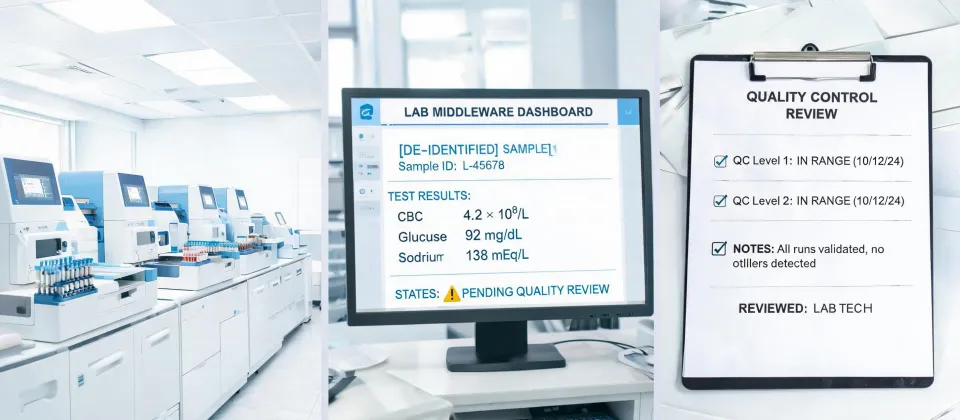
- Check the last QC pass timestamp — if it's >12 hours old, run a fresh liquid QC. Don't trust the onboard auto-QC alone.
- Verify reagent lot numbers against the central lab's reference range bridge.
- Confirm the wireless link to the middleware is alive. A disconnected Roche cobas b 101 won't transmit to the EMR, and you'll be handwriting results at 4 AM.
One often-missed point: the temperature log on the storage refrigerator. Our hospital had a faulty cooler in the satellite ED that drifted to 12°C one summer weekend. Nobody noticed until a batch of D-dimer assays failed. That's a 10-second check.
Step 2: Pre-Load AI-Assisted Interpretation Pathways
Roche's digital health AI platform (like the navify® algorithm suite) can cut interpretation time for ECGs and basic imaging — but only if you've already selected the right pathway. The conventional wisdom is to wait until the data streams in, then decide which AI module to run. I found that backwards.
My rule: when the triage note mentions 'chest pain' or 'SOB', I pre-load the STEMI detection algorithm and the Bayesian troponin probability model before the first blood draw even reaches the POCT area. That way, the AI has a baseline ready.
Here's the real surprise: the AI didn't just speed things up — it caught an subtle anterior STEMI in a left bundle branch block patient that two senior residents both called 'old LBBB.' The algorithm flagged it at 3:08 AM. The patient was in the cath lab by 3:42. That's a door-to-balloon time of 34 minutes. Game-changer.
Step 3: Sync the Imaging Queue — Don't Let a CT Slip
When you're juggling a suspected stroke with a possible type A dissection, medical imaging is your second pair of eyes. But I've seen too many delays happen because the CT order was entered as 'routine' instead of 'stat' at 2 AM. The scanner gets bumped by an elective exam scheduled for 7 AM. Sound familiar?
Checklist item: open the radiology booking queue and physically verify the priority level. Don't trust the verbal 'we called them' — I learned that after a March 2023 incident where a verbal request was lost in shift change. The patient waited 47 minutes for a scan that should have taken 15. (Consequence: the thrombectomy window nearly closed.)
Also, pre-configure the scanning protocols if possible. For a suspected stroke, make sure the perfusion CT protocol is loaded and the contrast injector is primed. Our team now uses a laminated quick-reference card taped to every scanner console in the ED. Cheap insurance.
Step 4: Prep for the Cardiac Stent Pathway — Even If You're Not Sure Yet
Not every chest pain leads to the cath lab. But when the troponin starts rising and the ECG shows dynamic changes, you need the lab's coagulation results (PT/INR, ACT) and a recent creatinine to clear the patient for angioplasty. Waiting for those results while the team scrubs is a classic bottleneck.
What I do: if the risk score (HEART or TIMI) is ≥4, I ask the POCT operator to run an additional INR and a creatinine (if the patient isn't on dialysis) before the official order comes in. The Emergency Department's 'just in case' drawer of Roche cobas b 123 POC analyzers handles this. Sure, sometimes you waste a cartridge. But I've had exactly zero delays to the cath lab from missing lab values since implementing this proactive draw. The cost of one wasted INR cartridge (~$8) vs. a 20-minute delay to revascularization? No-brainer.
Step 5: Don't Forget the 'Non-Urgent' Urgent — Prosthetic vs Orthotic Consult
This one sounds weird in an emergency checklist, but hear me out. Every trauma that involves limb salvage, amputation, or severe fracture will eventually need a prosthetic or orthotic plan. The decision prosthetic vs orthotic starts with the initial imaging and wound assessment. If the orthotist isn't told until the patient is discharged, you lose days of rehab planning.
My late-night trick: when I see a below-knee amputation or a complex pilon fracture on the CT report, I tag the EMR with a future consult note that flags the need for a prosthetics/orthotics evaluation. I include the imaging accession number, the anticipated mobility level, and whether a temporary orthosis might expedite discharge. It takes 90 seconds. And it prevents the 'oh, we forgot to order that' phone call three weeks later.
I once had a patient with a traumatic transtibial amputation who went home with a provisional orthosis 5 days after injury — record time in our hospital — because I had made that note at 1:30 AM on the night of admission. The prosthetist later told me that early flag saved two weeks of scheduling backlog. That's satisfying.
Three Common Pitfalls (And How to Avoid Them)
Pitfall #1: Over-reliance on 'Auto' Mode
POCT analyzers have come a long way. Roche's cobas 6800 even auto-dilutes and auto-interprets. But automatic doesn't mean infallible. I caught a false-positive hCG once because the sample had a clot that the sensor misread. Now I always glance at the raw signal curve before accepting the result — a habit I picked up after a false positive nearly triggered an unnecessary ultrasound.
Pitfall #2: Assuming the AI Works the Same at 3 AM
The algorithm was trained on data from 9-to-5 hours? I don't know. But I've seen the navify® ECG module give a lower confidence score for nocturnal waveforms (maybe due to less training data at night). We cross-check with manual review more aggressively during off-hours. 5 minutes of verification beats 5 days of correction.
Pitfall #3: Communication Failures Between ED and Lab
I said 'stat cardiac panel.' The lab heard 'routine panel, priority not specified.' The result: a 40-minute delay. Now every stat order includes the keyword 'CALLBACK' in the comment field, which triggers a phone confirmation. We haven't had a mis-prioritized order since that change in June 2023. Simple fix. Huge payoff.
Bottom Line
Prevention in emergency diagnostics doesn't mean doing less — it means doing the right 5% of preparation that prevents 95% of the friction. The checklist above saved our ED an estimated $8,000 in potential rework and, more importantly, shaved an average of 12 minutes off our door-to-therapy times last year. That's time the patient gets back. And that's the only metric that matters.
